

Partner with Us in Shaping
The Future of Intelligence
We are building World's First Universal Interpretation Model - Mātr, a bold, future-defining venture that merge innovation, culture, and technology. Our investors are not just funders - they are co-architects of change. On this page, you’ll find the resources to understand our vision, explore our growth plans, and connect directly with us for deeper conversations.
Explore the Opportunity
Get an overview of our vision, market opportunity, and business model through our Investor Teaser Deck. This document provides the key insights you need before diving deeper.
Language is the cognitive interface between human minds and the world.
It is how communities interpret, categorize and assign value to signals they encounter.

Solving Current AI’s
Biggest Blind Spot
Introducing World’s First Universal Interpretation Model
What ZWAG is building
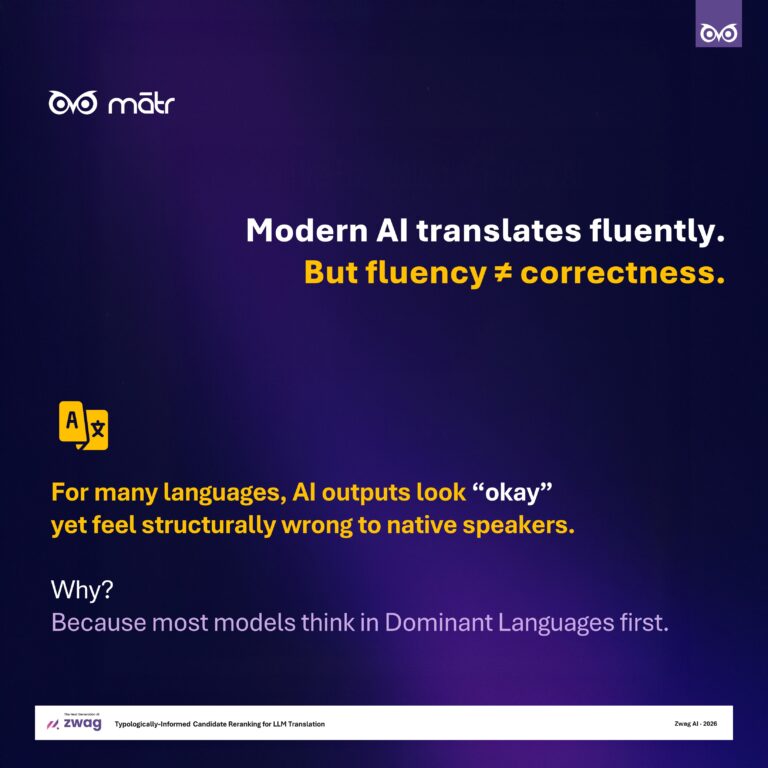
ZWAG AI is a deep-tech AI company in DIFC focused on solving one of the most persistent structural problems in AI: making modern AI systems truly usable across the world’s languages, especially where today’s models systematically fail.
Our flagship product is Mātr, built on an internal framework we call the Universal Metalinguistic Framework (UMF).
What is Mātr
Mātr is a model-agnostic enabling layer that integrates with existing LLMs. We do not replace models, retrain them, or compete with foundation model creators. Instead, we increase their global usability, particularly in linguistically and culturally divergent languages.
POC
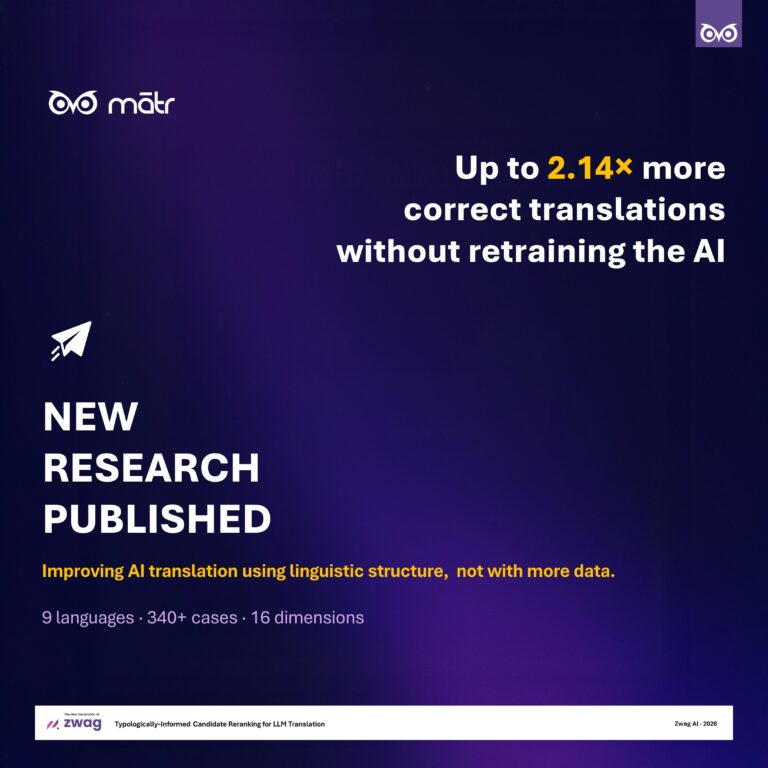
We posted our pre-print
Proof so far for Mātr
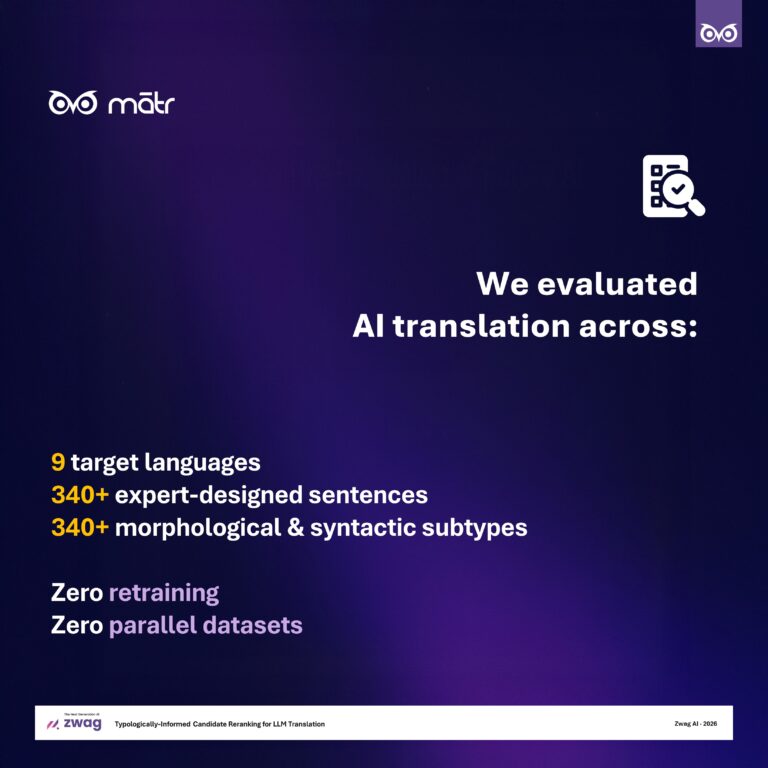
Tested across 9 languages
Detected ~15% semantic & morphological errors in ChatGPT (5.2) outputs
Corrected 60%+ of those errors
Achieved up to 2× improvement in correct interpretations - without retraining the model
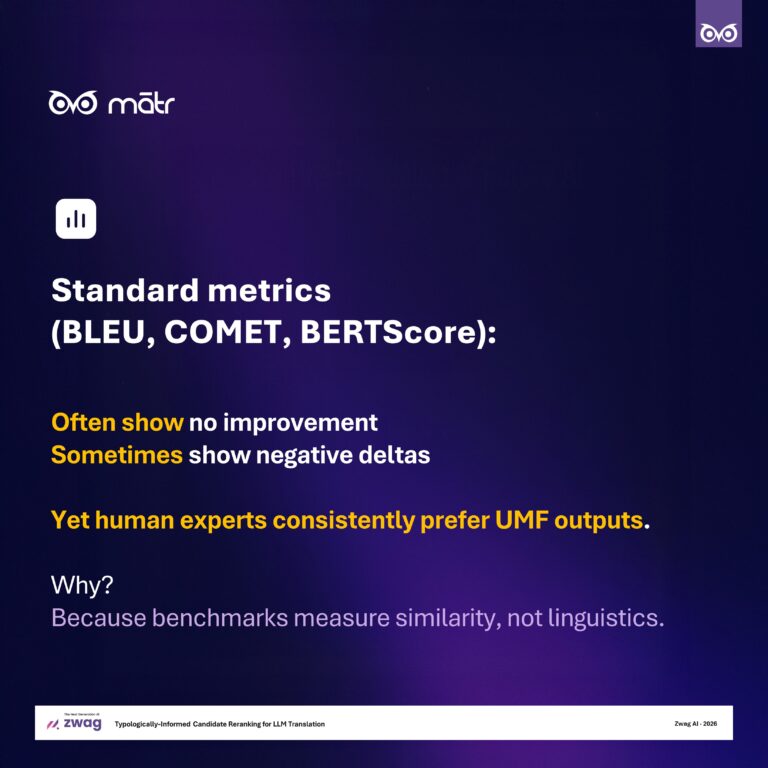
Our framework detected errors in LLM output that Existing Benchmarks like BLUE and COMET scores missed.
ASK
We are now going for two fundraising stages:
Pre-seed – US$250,000
Instrument: SAFE (preferred)
Purpose: expand typological dataset creation, strengthen the UMF → Mātr product layer, scale evaluation infrastructure, and prepare integration-ready pilots.
Seed – US$5,000,000
Instrument: priced equity round
Purpose: large-scale dataset expansion, production-grade platform build, enterprise and institutional deployments, and commercial partnerships with AI model creators and platforms.
INVESTOR FAQs
PREAMBLE / DISCLAIMER TO INVESTOR
Mātr is an early-stage, pre-seed company. We are currently in the proof-of-concept phase, and the core technology still requires significant research, experimentation, and validation. This is frontier work, meaning the pathway includes trial, error, and iteration.
However, the rewards of getting this right are exceptionally high. A working Universal Interpretation Model doesn’t just improve multilingual AI, it becomes foundational infrastructure for global AI systems, unlocking multiple revenue pathways, future licensing models, and very high-value acquisition opportunities.
Today, our evidence is measured at the “interpretation-error” level, not just surface similarity scores.
What we measured (and how):
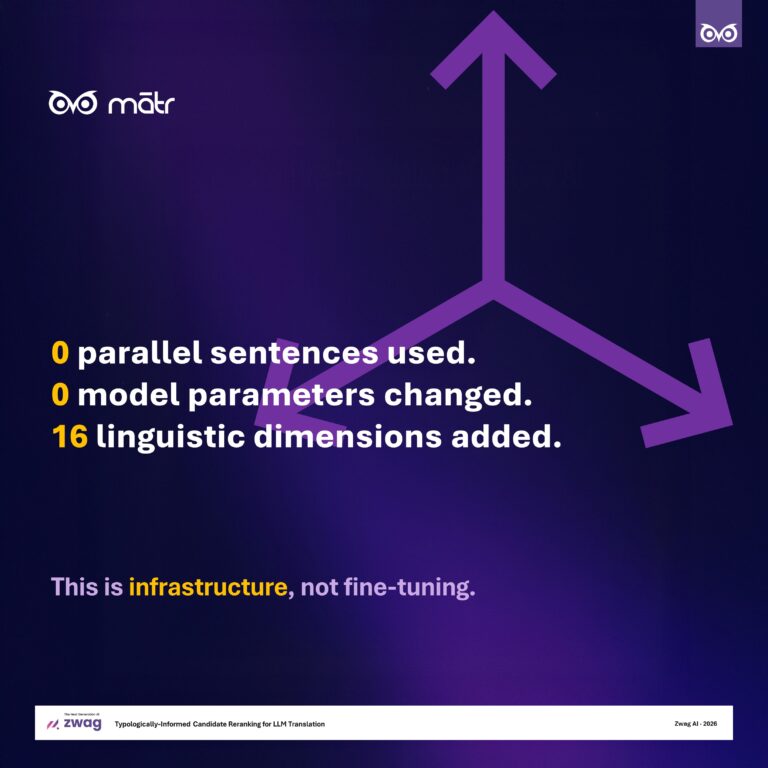
In our proof-of-concept study, we tested 341 English sentences designed to trigger specific morphological + syntactic phenomena, across 9 target languages. Mātr (UMF + computational engine) does inference-time candidate reranking on top of a baseline LLM’s outputs-no retraining and no parallel training data required.
Core measurable outcomes (human-validated):
Change Rate (Intervention Rate) – how often Mātr overrides the baseline top output because it detects an interpretation-level issue.
Example: Sinhala 45.16%, Tamil 26.69%, Hindi 15.54%, Arabic 11.44%, Chinese 3.23%.
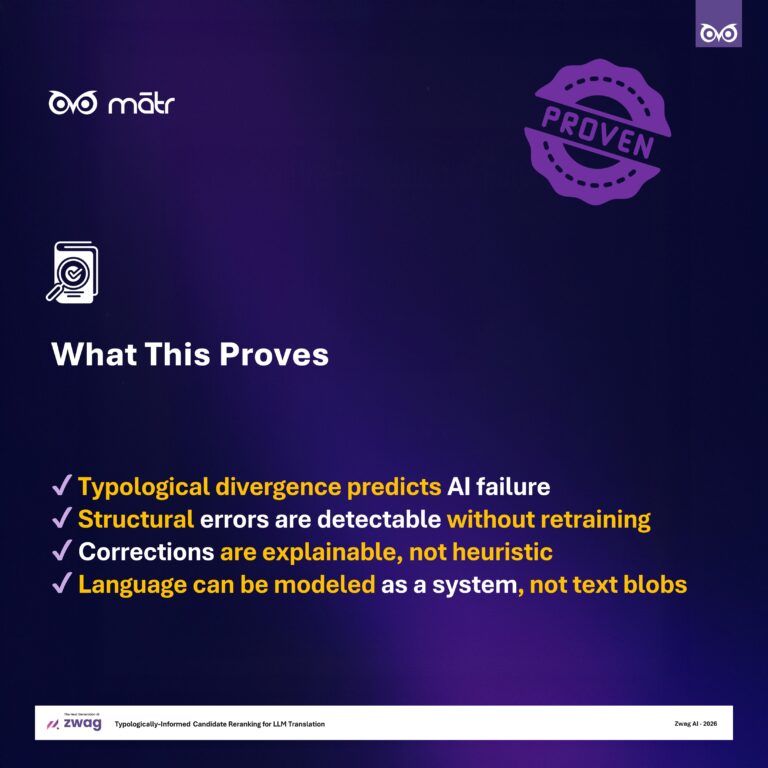
This rate correlates strongly with typological distance: Pearson r = 0.82 (p < 0.01), meaning Mātr intervenes more when languages structurally diverge more from English.
Intervention Precision – when Mātr intervenes, how often the change is judged a correct improvement by expert native-speaker evaluation.
Chinese 100%, Hindi 84.91%, Arabic 79.49%, French 80.65%, Japanese 76%.
We also report lower precision in morphologically dense + underspecified-profile languages (e.g., Sinhala/Tamil), which we explicitly treat as a known limitation and the key driver for why dataset expansion matters.
Gain–Risk Ratio – the “ROI per mistake”: correct improvements divided by UMF-introduced errors.
Hindi 2.14, Chinese 1.83, French 1.09, Arabic 1.00 (net-positive).
This metric is important because it answers: even if we sometimes introduce errors, are we net improving the system? In several languages, yes-already.
Why standard MT metrics don’t show big deltas yet (and why that’s expected):
We evaluated BLEU/chrF/COMET/BERTScore and found they often show small or even negative deltas, even when expert reviewers confirm meaningful structural improvements (case marking, argument structure, word order, register, etc.). This is a central finding: current metrics are weak at detecting typological correctness and interpretation-level errors in underrepresented languages.
How we validated (so this isn’t “we eyeballed it”):
All interventions were assessed via blind native-speaker expert evaluation, with two independent evaluators, adjudication on disagreements, and substantial agreement (Cohen’s κ ≈ 0.71 average).
Bottom line (the investor-plain-English claim you can safely make today):
Mātr shows measurable, human-validated improvements in several languages (notably Chinese/Hindi/Arabic/French/Japanese), with high intervention precision and net-positive gain–risk.
In very morphologically dense low-resource languages (Sinhala/Tamil), Mātr shows high sensitivity (detects many likely interpretation issues) but insufficient resolution today-exactly why the pre-seed is focused on expanding typological profiles and datasets to increase precision.
To date, Mātr has already raised and deployed US$55,000, with the majority utilized toward early research, framework development, and technical validation.
We are now planning two fundraising stages:
- Pre-seed – US$250,000 (SAFE preferred): expand typological dataset creation, strengthen the UMF → Mātr product layer, scale evaluation infrastructure, and prepare integration-ready pilots.
- Seed – US$5,000,000 (priced equity round): large-scale dataset expansion, production-grade platform build, enterprise and institutional deployments, and commercial partnerships with AI model creators and platforms.
We’ve aligned these with the pitch deck roadmap.
Technical Deliverables
- Mātr Foundation (Alpha) covering 10–50 diverse root languages
- Full proof-of-concept demonstration across these languages
- Prototype semantic interpretation engine (UMF + computational engine + middleware layer)
- Preliminary conversion + interpretation pipeline
Business Deliverables
- Technical white paper (Q1 2026)
- Three research partnerships with leading AI/NLP institutions
- Initial patent filings for the Universal Metalinguistic Framework (UMF), cultural encoding datasets, and middleware architecture
- Pilot-ready API by Month 9–10
Timeline: All targets within 12 months of closing. We are on track to submit the first paper as early as January if experiments firm up.
Today, Mātr does not claim full production “support” for languages in the conventional sense (i.e., plug-and-play translation quality across all domains). Instead, we operate at a more foundational level: language profiling and interpretation intervention.
What we support today (current state):
- We have active UMF / Mātr language profiles with measurable evaluation results for 9 languages, selected to span a wide typological range (including Indo-Aryan, Dravidian, Semitic, Sinitic, Japonic, and Romance families).
- These languages are the ones reported in our paper, where Mātr performs inference-time intervention, reranking, and correction, with human-validated results.
- For these languages, Mātr can detect interpretation-level issues, intervene, and in several cases produce net-positive semantic improvements-but we are explicit that some languages (e.g., morphologically dense, low-resource ones) still have lower precision today.
What “support” means in our context:
For Mātr, supporting a language means:
- Having a formal typological and divergence profile
- Being able to compute divergence vectors against a pivot language
- Running structured evaluation loops (change rate, intervention precision, gain–risk ratio)
- Enabling model-agnostic intervention, not training a new language model
This is fundamentally different from claiming full translation or generation coverage.
What we realistically expect within 12 months (post pre-seed):
- 25–40 fully profiled root languages, each acting as anchors for language families
- Coverage expansion through family-level generalization, allowing derivative handling of hundreds of related languages and dialects
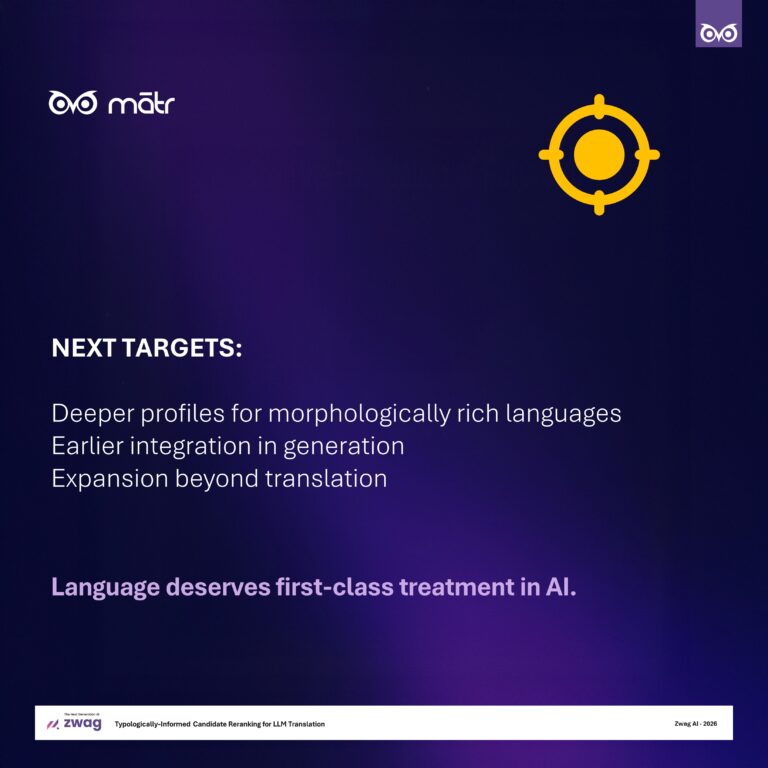
- Significantly improved precision for today’s weakest languages through expanded typological datasets, not brute-force data scaling
We intentionally prioritize depth over breadth. Each additional language requires careful linguistic modeling, not just data ingestion. This is slower than traditional multilingual expansion-but creates defensibility and correctness.
Why this number is credible:
- Our profiling process is semi-automated but linguist-supervised, and already validated in the current study
- The limiting factor today is typological data creation, not model capability
- The pre-seed round is explicitly designed to scale this pipeline safely without degrading linguistic integrity
Bottom line:
Within 12 months, Mātr will not “support hundreds of languages” in a shallow way. Instead, it will support dozens of deeply modeled root languages, enabling structurally correct interpretation across a much larger portion of the world’s linguistic diversity-something current multilingual models cannot reliably do.
Today, Mātr does not claim full production “support” for languages in the conventional sense (i.e., plug-and-play translation quality across all domains). Instead, we operate at a more foundational level: language profiling and interpretation intervention.
What we support today (current state):
- We have active UMF / Mātr language profiles with measurable evaluation results for 9 languages, selected to span a wide typological range (including Indo-Aryan, Dravidian, Semitic, Sinitic, Japonic, and Romance families).
- These languages are the ones reported in our paper, where Mātr performs inference-time intervention, reranking, and correction, with human-validated results.
- For these languages, Mātr can detect interpretation-level issues, intervene, and in several cases produce net-positive semantic improvements-but we are explicit that some languages (e.g., morphologically dense, low-resource ones) still have lower precision today.
What “support” means in our context:
For Mātr, supporting a language means:
- Having a formal typological and divergence profile
- Being able to compute divergence vectors against a pivot language
- Running structured evaluation loops (change rate, intervention precision, gain–risk ratio)
- Enabling model-agnostic intervention, not training a new language model
This is fundamentally different from claiming full translation or generation coverage.
What we realistically expect within 12 months (post pre-seed):
- 25–40 fully profiled root languages, each acting as anchors for language families
- Coverage expansion through family-level generalization, allowing derivative handling of hundreds of related languages and dialects
- Significantly improved precision for today’s weakest languages through expanded typological datasets, not brute-force data scaling
We intentionally prioritize depth over breadth. Each additional language requires careful linguistic modeling, not just data ingestion. This is slower than traditional multilingual expansion-but creates defensibility and correctness.
Why this number is credible:
- Our profiling process is semi-automated but linguist-supervised, and already validated in the current study
- The limiting factor today is typological data creation, not model capability
- The pre-seed round is explicitly designed to scale this pipeline safely without degrading linguistic integrity
Bottom line:
Within 12 months, Mātr will not “support hundreds of languages” in a shallow way. Instead, it will support dozens of deeply modeled root languages, enabling structurally correct interpretation across a much larger portion of the world’s linguistic diversity-something current multilingual models cannot reliably do.
Our strategy is simple: become valuable enough that the LLM provider acquires us, eliminating the need to access internal layers externally.
However, technically, Mātr integrates without internal access:
- Prompt-side / Candidate side (Via APIs) interpretation injection
- Semantic routing layer
- Attention-guidance vectors through existing APIs
- Post-generation reinterpretation to prevent semantic drift
- Synthetic Data usage
But the real path is acquisition.
If they buy us, integration becomes native, seamless, and deeply optimized, saving them time for R&D and giving them a defensible advantage.
Moat Components:
- First mover in semantic-preservation middleware
- Universal Metalinguistic Framework (UMF), a dataset + logic structure nobody is building
- Cultural, morphological, and semantic datasets that cannot be replicated quickly
- Network effects (more languages → more valuable → harder to copy)
- Infrastructure play, not another B2C AI product
- Direct alignment with AI ethics + fairness regulations (EU AI Act, GCC frameworks)
Why Big Tech won't just rebuild this:
Because the UMF dataset and interpretation logic is not a “model feature”, it’s a multi-year linguistic, cultural, and cognitive mapping effort.
If we are open to acquisition, it’s irrational for them to spend years recreating/figuring out the approach, going against their usual development pathways to do the same thing.
We are the shortcut, and we are open for acquisition.
Current signals of credibility:
- Internal linguistic validation led by Parameshwari, IIT Hyderabad (specialist in cross-linguistic morphology + semantics)
- Early adoption interest from:
- A Romania based Agentic AI company
- A KSA - based voice-AI company entering Africa
- An India-based AI platform supporting deaf and hard-of-hearing children
- POC validated as “non-disruptive” to LLM architectures (confirmed through systematic injection testing)
Academic Alignment:
Our approach aligns with research from:
- Noam Chomsky & Berwick’s work on Universal Grammar + computational linguistics
- Steven Pinker, Goldberg, Evans on cognitive semantics
- IIT Hyderabad / Dravidian NLP frameworks
- Global typology sources like WALS & UD
Upcoming:
- Technical paper (Jan 2026)
- 3 formal research partnerships (goal post-SAFE)
We are not building a new LLM, so we do not need a classical “LLM lab team.”
Instead, we are building interpretation infrastructure. Our team reflects that:
- Parameshwari – Linguistic intelligence lead (IIT Hyderabad). Deep expertise in South Asian languages, morphology, and semantics.
- Nipuna (CIO) – Built internationally patented AI systems; led multiple deep-tech R&D projects, worked with early-stage startups for more than 15 years.
- Ashen W. – 10+ years at WSO2, world-class middleware expert.
- Samith – Deep-tech AI + IoT researcher; computational systems architect.
- Pubudu – Mathematician, physicist, quantum computing researcher (University of Pittsburgh). Designs UMF computational logic.
- Dulmini – Cultural semantics and education
- Shivalatha S. – Language Research Officer; leads language research and linguistic data initiatives.
- Yasitha N. – Head of XR & AI Interfaces; oversees immersive interface development.
- Priya M. Nair – Founder & Chief Executive Officer; guides strategy, partnerships, and operations.
- Linguistics Team and Development team – Multiple professors and computational linguists across institutions. Full stack developers and linguistic data annotators.
This is the interdisciplinary composition required for a universal interpretation layer at this stage.
We are not building a sales-led business.
We are building an acquisition-driven frontier technology.
Plan A - Acquisition (Primary Route):
Demonstrate strong POC > publish technical paper > secure partnerships > initiate acquisition discussions with OpenAI, Google, Anthropic, etc.
We target an exit within 24 months.
In this space, foundational AI infra startups are acquired in as little as 6–12 months.
Plan B - Licensing model (if acquisition is delayed):
- API usage-based licensing
- On-prem enterprise semantic middleware
- Integration for agentic AI companies
- Special licensing for governments, telcos, or multilingual platforms
But licensing is the fallback-not the core plan.
Risk 1: AI moves beyond transformers
Contingency:
UMF is model-agnostic. It can adapt to:
- World models
- State-space models
- Object-centric architectures
- Mixture-of-experts (MoE) stacks
Risk 2: Low-resource languages suddenly get huge datasets
Contingency:
Mātr does not depend solely on data.
It provides structural interpretation, cultural logic, morphology, semantics, pragmatics, independent of dataset size.
We strengthen models even when data improves.
Risk 3: Difficulty scaling feature engineering
Contingency:
We are creating semi-automated extraction tools + embedding-based meta-feature clustering to scale UMF faster than manual methods.
Risk 4: Big tech replicates the idea
Contingency:
Our dataset + UMF architecture + head start + willingness for acquisition = strong defense.
Rebuilding culturally grounded semantic logic is a multi-year linguistic effort, not something big tech can spin up quickly.
Zwag is intentionally built as an acquisition-friendly deep-tech company. Our long-term goal is to position Mātr as an essential multilingual AI infrastructure layer that enables all models to understand and reason about language at a deeper level. Because we are assembling proprietary typological datasets and operationalizing linguistic divergence into mathematics through the UMF architecture, our platform cannot be easily replicated and does not depend on any single model architecture.
Our pathway to exit follows the strategy described in the pitch deck’s Plan A: demonstrate a compelling proof-of-concept, publish technical papers to validate the science, secure pilot partnerships with major AI labs and platforms, and then initiate acquisition discussions. Leading AI companies (e.g., OpenAI, Google, Anthropic) routinely acquire enabling technology startups once they have demonstrated unique capabilities. Foundational AI infrastructure companies in this space have been acquired in as little as 6–12 months after demonstrating value.
Given our model-agnostic design, proprietary datasets, and readiness for integration into large-scale platforms, we believe an acquisition at valuations over US$100 million is realistic once our technology is proven and adoption grows.
Perspective on how we’re thinking about Mātr (ZWAG) valuation in the context of recent AI acquisitions & strategic acquihires.
We’re seeing a clear pattern where deep infrastructure / enabling-layer AI companies (not application SaaS) are being acquired in the $200M – multi-billion range, even at relatively early revenue stages, because they unlock capabilities across many models and products:
- GPU / infra optimization → $300M–$700M range
- Embedding / semantic infrastructure → ~$200M+
- Acquihire + license structures → $600M–$2.4B
- Strategic AI security / platform layers → multi-billion
Mātr sits in a similar strategic category:
We do not build an LLM.
We augment all LLMs by fixing their deepest weakness: linguistic & cultural interpretation across divergent languages.
All major model creators become customers, not competitors.
Our defensibility comes from proprietary typological datasets + divergence-to-math framework, which currently does not exist in the world.
We’ve already deployed ~$55k into building the core framework, early language profiles, and evaluation pipeline. With focused capital, we scale this into a platform that becomes a default semantic layer for global AI.
From that lens, a $100M+ forward valuation is not based on current revenue, but on:
- Platform-level strategic importance
- Horizontal applicability across every AI model
- Clear acquisition appetite from Big Tech for exactly this type of layer
We’re raising via SAFE for pre-seed, with a path toward a larger seed round and an explicit acquisition-friendly trajectory.
What is the latency and cost overhead per inference when Mātr runs?
- Latency: ~5 ms per request (reranking + scoring only)
- Cost overhead: ~1.05× maximum of a single base inference based on our estimations
- Driven by requesting 2–4 candidates instead of one
- No training, no fine-tuning, no extra model hosting
- Small, predictable overhead suitable for enterprise, voice, and agentic use cases
Mātr reliably improves interpretation correctness, the class of errors current metrics and models systematically miss.
This is not best-case tuning.
These results are conservative, human-validated, and reproducible across languages.
If OpenAI / Anthropic built this internally, how long to catch up?
- Realistic timeline: 12–24 months
- Bottleneck is not engineering speed, but:
- Language-by-language typological modeling
- Expert linguistic validation
- Converting linguistic constraints into computable logic
- In practice, acquisition is faster and cheaper than rebuilding
Let’s Talk Possibilities
Stay Connected
Subscribe to our Investor Newsletter to receive updates on milestones, funding rounds, and exclusive opportunities.
Contact Us
Let’s Build the Future Together
Feel free to reach out. Our team is ready to explore meaningful collaborations and respond to your inquiries with thoughtfulness and prompt attention.
At Mātr, we’re not just building technology - we’re reshaping how the world understands itself. Every collaboration is a step toward a more connected, intelligent future.
Priya M Nair
Founder & CEO