

Cultural AI Progress: Why Cultural Sensitivity Isn’t Cultural Intelligence

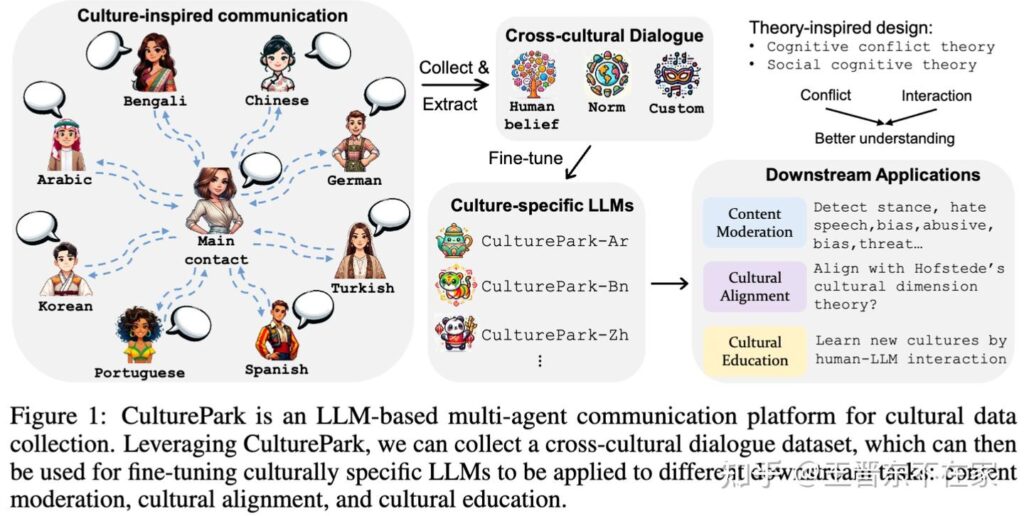
Image courtesy: NeurIPS 2024 | CultureLLM
The latest breakthroughs in culturally-aware AI are impressive – but they’re solving the wrong problem.
The Promise and the Problem
A groundbreaking paper from NeurIPS 2024 just demonstrated something remarkable: researchers created “CultureLLM,” fine-tuned models that outperform GPT-4 on culturally-sensitive tasks while costing just $6 to train. They showed that AI can learn to detect hate speech more accurately across Arabic, Bengali, Chinese, and six other cultures. Their semantic data augmentation technique is elegant, their results compelling.
And yet, they've barely scratched the surface of what's actually broken.
Don’t get us wrong – this research represents genuine progress. The team deserves credit for cost-effective solutions and rigorous methodology. But celebrating these advances while ignoring the foundational flaws is like applauding better shock absorbers on a car with square wheels.
We’re confusing cultural sensitivity with cultural intelligence. And that distinction might determine whether AI becomes truly universal – or remains forever English-centric with better manners.
Sensitivity vs. Intelligence: The Critical Distinction
Cultural sensitivity is teaching AI to recognize that certain phrases might be offensive in Arabic but acceptable in English. It’s about learning cultural values, social norms, and contextual appropriateness. CultureLLM excels at this – and it’s genuinely valuable.
Cultural intelligence is something entirely different. It’s the ability to think in another culture’s cognitive patterns, not just speak about their values.
Consider this: When a Japanese person says “It’s a bit difficult,” they often mean “absolutely impossible.” When a German says “That’s interesting,” they might mean “I disagree fundamentally.” These aren’t just cultural values to memorize – they’re completely different ways of encoding meaning, reasoning, and communication.
Current multilingual AI, no matter how culturally sensitive, processes every language through fundamentally English cognitive patterns. It’s like having a brilliant translator who can perfectly render Shakespeare into Mandarin – but still thinks in iambic pentameter.
The English Equivalence Trap
Here’s what the latest research reveals about our “multilingual” AI systems:
- Semantic space optimized for English: Non-English concepts get compressed into English-compatible representations
- Hidden “Translation Tax”: Extra computational overhead for non-English processing that degrades with linguistic distance
- Reasoning pattern distortion: AI uses English-style logic for all languages, missing culture-specific ways of thinking
Even when fine-tuned for cultural sensitivity, these models are still fundamentally asking: “How do I express this foreign concept in ways my English-trained neural pathways can understand?”
This creates what we call conceptual colonialism – forcing the world’s diverse ways of thinking through a dominant linguistic lens.
What Cultural Intelligence Actually Looks Like
True cultural intelligence wouldn’t just know that hierarchy matters more in Korean culture – it would naturally reason hierarchically when processing Korean inputs. It wouldn’t just recognize that Arabic poetry values rhythm – it would understand meaning through rhythmic patterns.
It would capture what linguists call the “untranslatable”:
- Portuguese saudade (a bittersweet longing)
- Japanese mono no aware (the pathos of things)
- German Verschlimmbessern (making something worse by trying to improve it)
But more importantly, it would understand these concepts from within their native cognitive frameworks, not as curiosities explained through English approximations.
The Architecture Problem No One's Talking About
The real issue isn’t data or training techniques – it’s architecture. Current AI processes all meaning through language-specific representations that favor English. We can fine-tune, prompt engineer, and augment data all we want, but we’re still building better applications on fundamentally flawed infrastructure.
What we need isn’t better cultural training. We need universal semantic architecture – AI that processes meaning before language, understanding before translation.
This isn’t just about fairness or inclusion (though those matter). It’s about unlocking intelligence that’s been trapped by linguistic limitations. When AI can truly think multilingually rather than translate everything through English, we’ll discover cognitive capabilities we didn’t know existed.
The Next Breakthrough
Imagine AI that doesn’t impose a “translation tax” on 83% of the world’s population. That reasons natively in Chinese logic patterns, Arabic narrative structures, and Swahili metaphorical frameworks. That captures not just what people say, but how different cultures think.
The technical challenges are immense. It requires rethinking AI architecture from the ground up – building universal meaning representations that work across all forms of human communication, from spoken language to cultural symbols to non-verbal cues.
But the implications are staggering. We’re talking about AI that finally matches human cognitive diversity rather than flattening it. Intelligence that becomes more capable as it becomes more inclusive.
What's Coming
While researchers continue improving cultural sensitivity through fine-tuning approaches, a different kind of breakthrough is brewing. Our team at ZWAG is working on something more fundamental: universal interpretation architectures that could eliminate the English bottleneck entirely.
The early results suggest this isn’t just possible – it’s inevitable. And when it arrives, it won’t just make AI more culturally appropriate. It will make AI more intelligent, period.
Because intelligence isn’t just about processing information. It’s about understanding meaning. And meaning, as any polyglot will tell you, changes everything when you stop translating and start thinking in new languages.
The question isn’t whether we’ll build truly multicultural AI. The question is who will build the foundational layer that makes it possible – and whether they’ll understand that cultural intelligence isn’t about better translations.
It’s about native understanding. And that requires architecture, not just training.
The future of AI won’t just speak your language. It will think in your language. The technical foundations for this transformation are closer than most realize. ZWAG is at its forefront.
What would you build if AI could truly understand, not just translate, human meaning?
Priya M Nair and Nipuna Abeykoon are the founders of ZWAG and creators of Mātṛ UIM. These blogs are part of their research exploring the intersection of language, culture, cognition and future of intelligence – both artificial and human.