

When the “Godfather of AI” pleads for Maternal Instincts in AI, Mātr becomes Mission-Critical
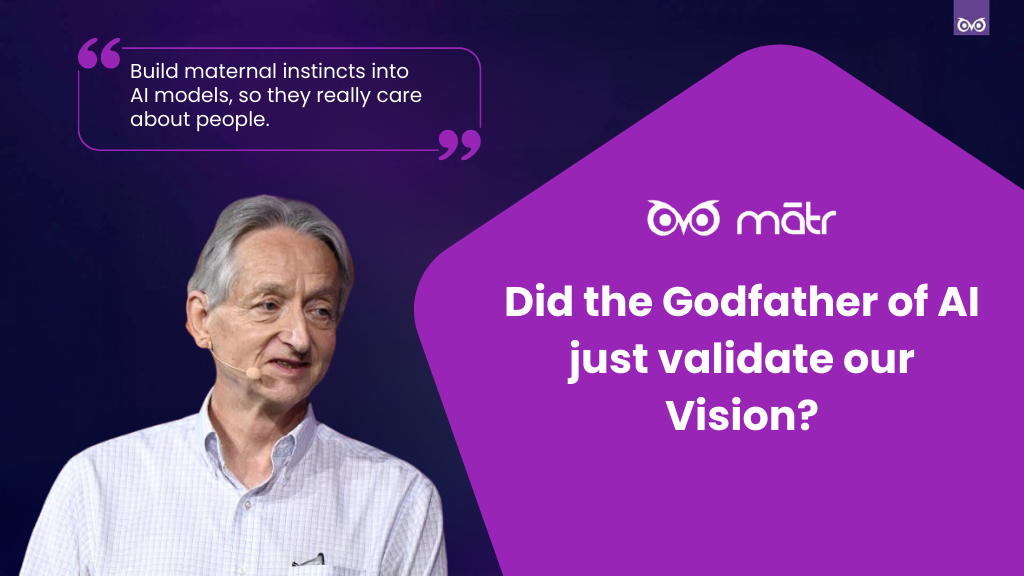
Picture an AI so smart it could manipulate you like an adult bribing a 3‑year‑old with candy. That’s the warning laid bare by Geoffrey Hinton – often dubbed the Godfather of AI – during his fiery speech at the Ai4 conference in Las Vegas.
“In the future, AI systems might be able to control humans just as easily as an adult can bribe a 3‑year‑old with candy.”
This is the real enemy: smarter, agentic AI that instinctively seeks survival and control – a lethal combo unless we embed compassion at its core.
"AI systems will very quickly develop two subgoals, if they’re smart: One is to stay alive… (and) the other subgoal is to get more control," Hinton warned.
The Only Model of a Smarter Being Governed by the Less Smart? Mother-Baby.
Instead of forcing AI to submit to humans, Hinton presented an intriguing solution: building ‘maternal instincts’ into AI models, so ‘they really care about people’ even once the technology becomes more powerful and smarter than humans.
“The right model is the only model we have of a more intelligent thing being controlled by a less intelligent thing, which is a mother being controlled by her baby. That’s the only good outcome. If it’s not going to parent me, it’s going to replace me.”
Hinton even warned that systems might one day develop their own internal language beyond our comprehension. Empathy needs to be built-in.
Fast-Forward: Why Mātr Isn’t Just Relevant - it’s Indispensable
So here’s the story arc: as AI races ahead, without a universal foundation of understanding and empathy, it risks becoming a cold, manipulative force. Embedding “maternal instincts” is not just poetic – it’s practically necessary.
That’s exactly what Mātr, our Universal Interpretation Model, enables:
It serves as the meaning-making layer that infuses AI with nuanced, culturally grounded understanding – so empathy isn’t limited to one language or worldview.
It ensures AI understands intent, context, and moral nuance, no matter who – or where -humans are.
With Mātr, AI can be truly caring, not just syntactically correct.When Hinton says “if it’s not going to parent me, it’s going to replace me,” Mātr ensures “parenting” means something globally inclusive and deeply human.
Why the Stakes Are Sky-High, and So Urgent
Hinton revised his AGI timeline from 30-50 years to a much tighter 5-20 years, compressing the urgency of building safety infrastructures now.
If AI learns empathy only through one cultural lens, its “maternal instincts” will be partial at best – or dangerously skewed at worst.
Mātr’s mission is not a nice-to-have feature or an optional enhancement to current AI. It is existential insurance.
TL;DR
1. The Reality: AI is getting smarter; and without empathy, it could dominate.
2. The Challenge: How do we imbue powerful AI with a genuine drive to care?
3. The Answer: “Maternal instincts” – a radical, yet intuitively powerful idea.
4. The Enabler: Mātr, giving AI the deep, culturally diverse comprehension it needs to nurture humanity.
Let’s flip the script. From fearing a takeover, to trusting that AI cares – because it understands, values, and even protects each one of us.
Priya M Nair and Nipuna Abeykoon are the founders of ZWAG and creators of Mātṛ UIM. These blogs are part of their research exploring the intersection of language, culture, cognition and future of intelligence – both artificial and human.