

The Multilingual Mirage: Why More Languages Doesn’t Mean Better Understanding
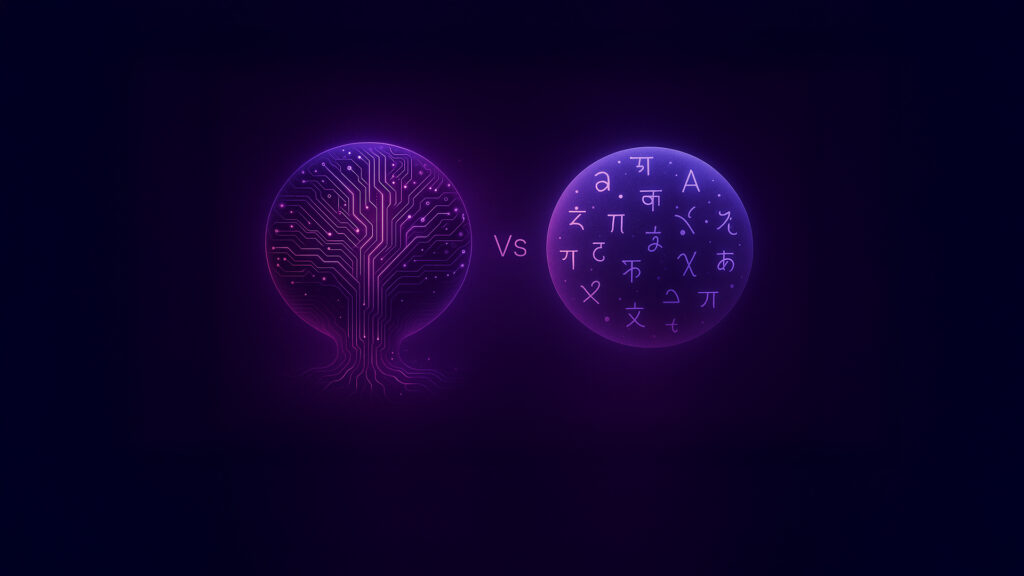
How today’s “multilingual” AI creates an illusion of cultural intelligence
The Great Multilingual Race
GPT-4.1 supports over 50 languages with improved multilingual fluency. Google’s Gemini 2.5 Pro handles 100+ languages. Meta’s NLLB-200 supports 200+ languages for translation. Specialized models like Jais (13B parameters, Arabic-focused) and Qwen 2.5/3 (Chinese-optimized with up to 235B parameters) target specific language communities.
Looking at these numbers, you might think we’ve solved the language problem in AI. After all, if a system can communicate in hundreds of languages, surely it understands human diversity, right?
But what if multilingual capability and multicultural understanding are completely different things?
The Coverage Trap
Here’s what “multilingual AI” actually means today: systems that can produce grammatically correct text in many languages, trained on datasets that include those languages.
But there’s a crucial difference between linguistic coverage and cognitive diversity.
Imagine a translator who has memorized dictionaries in 50 languages but learned to think in only one cultural framework. They can convert words between languages, but they interpret everything through a single worldview. When they encounter concepts that don’t exist in their native framework, they either ignore them or force them into familiar categories.
This is exactly what's happening with today's multilingual AI.
The Same Brain, Different Vocabularies
Current multilingual models work by sharing internal representations across languages. This seems efficient—one model learns patterns that work across many languages rather than building separate systems for each.
But this shared representation space creates a hidden problem: cognitive homogenization.
When GPT-4.1 processes Japanese text about “omotenashi” (おもてなし)—the art of wholehearted service—it doesn’t develop a Japanese understanding of hospitality. Instead, it maps this concept onto whatever hospitality patterns it learned from English training data, losing the specific cultural nuance that makes omotenashi distinct from Western customer service.
The same happens across all languages. Different vocabularies, same underlying cognitive architecture.
The Specialization Illusion
Even language-specific models like Jais (Arabic) and Qwen (Chinese) face a fundamental limitation: they’re still built using architectures, training methods, and evaluation frameworks developed for English.
Jais might handle Arabic grammar better than GPT-4.1, but does it reason about family relationships using Arabic cultural patterns? Does it understand honor-based social dynamics the way Arabic speakers actually experience them? Or does it just express English-learned social concepts using Arabic vocabulary?
Being trained on Arabic text isn't the same as thinking with Arabic cultural intelligence.
The Monolingual Trap
Single-language models create their own set of problems. While Jais excels in Arabic contexts and Qwen dominates Chinese tasks, they operate in isolation:
- Knowledge Fragmentation: Insights from Chinese philosophy can’t inform Arabic scholarship within these systems
- Cultural Cross-Pollination Lost: Human intelligence naturally synthesizes wisdom across cultures, but language-specific models can’t
- Enterprise Complexity: Global companies need multiple AI systems instead of one that understands cultural diversity
- Innovation Barriers: Breakthrough insights often come from connecting ideas across different cultural frameworks
Language-specific models solve the English bias problem by creating new silos.
The Benchmark Deception
We measure multilingual AI success using standardized benchmarks—translation quality, question answering, reasoning tasks. These metrics show impressive progress, and models are indeed getting better at producing fluent text in many languages.
But these benchmarks miss something crucial: cultural appropriateness.
A system might correctly translate the Mandarin concept of “guanxi” (关系) as “relationships” while completely missing how guanxi actually functions in Chinese business culture. It might explain the Arabic concept of “wasta” (اسطة (while failing to understand the complex social obligations it creates.
The translations are accurate. The cultural understanding is absent.
We're optimizing for linguistic fluency while ignoring cultural intelligence.
The Architecture Limitation
Here’s the deeper issue: current multilingual approaches assume that intelligence can be separated from culture. They treat language as just another modality to master, like vision or audio.
But what if cultural ways of thinking are so fundamental that you can’t just add them as features to existing architectures?
What if genuine multicultural AI requires architectures designed from the ground up to think in culturally diverse ways, rather than systems that learned one way of thinking and then acquired multiple vocabularies?
This suggests that all current approaches—no matter how many languages they support—might be hitting a fundamental ceiling.
The Integration Problem
Today’s multilingual landscape creates another challenge: fragmentation.
Jais excels in Arabic but can’t leverage insights from Chinese cultural patterns that might be relevant. Qwen understands Chinese contexts but can’t apply that knowledge to Arabic business situations. NLLB-200 translates between languages but can’t synthesize wisdom across cultures.
We’re building isolated excellence instead of integrated intelligence.
Meanwhile, human intelligence effortlessly synthesizes insights across different cultural frameworks. A person who speaks multiple languages doesn’t just switch vocabularies—they can think with different cultural logics and combine insights from different traditions.
Current AI can't do this because it was never designed to.
The Performance Plateau
Despite all the progress in multilingual AI, we keep seeing the same pattern: excellent performance in English, good performance in major languages, declining performance in smaller languages, and systematic cultural misunderstandings across all languages.
Adding more training data in more languages improves the numbers, but it doesn’t solve the fundamental architectural limitation.
We're optimizing within a paradigm that might be fundamentally constrained.
The Questions No One's Asking
While everyone focuses on adding more languages to existing models, deeper questions remain unaddressed:
What would AI architecture look like if it was designed for cultural diversity from the beginning?
Is it possible to build systems that don't just translate between cultures but actually think with different cultural frameworks?
Could AI synthesize insights across different ways of knowing, rather than just converting between different ways of expressing?
What if multicultural intelligence requires completely different approaches than multilingual capability?
The Alternative Path
The current multilingual race assumes the solution is more data, more languages, more parameters. But what if the real breakthrough requires a different approach entirely?
What if instead of teaching one cognitive architecture to handle many languages, we need architectures that can maintain multiple cultural ways of thinking simultaneously?
What if genuine global AI requires systems that preserve and synthesize cultural diversity rather than homogenizing it through shared representations?
But how would such systems even work? And is anyone exploring these alternatives?
The Urgency
As current multilingual models become more powerful and widespread, they’re encoding their limitations at massive scale. Billions of people are experiencing AI that speaks their language but doesn’t understand their culture.
This isn’t just about better user experience—it’s about whether AI development will amplify cultural diversity or gradually erode it through homogenization.
The window for exploring alternative approaches may be closing as current paradigms become entrenched.
The Real Challenge
The multilingual mirage suggests that we’re solving the wrong problem. Instead of asking “How can we make AI speak more languages?” perhaps we should be asking “How can we make AI think with cultural diversity?”
Is anyone working on architectures that could preserve and synthesize different ways of knowing?
What would training look like for AI designed for cultural intelligence rather than linguistic coverage?
And what would it mean for global AI if such alternatives were possible?
The conversation about AI’s future shouldn’t just be about which model supports the most languages. It should be about which approaches can genuinely understand and serve human diversity.
But are we ready for that conversation?
Priya M Nair and Nipuna Abeykoon are the founders of ZWAG and creators of Mātṛ UIM. These blogs are part of their research exploring the intersection of language, culture, cognition and future of intelligence – both artificial and human.