

The Translation Tax: Why AI’s Hidden Bottleneck Affects Everyone
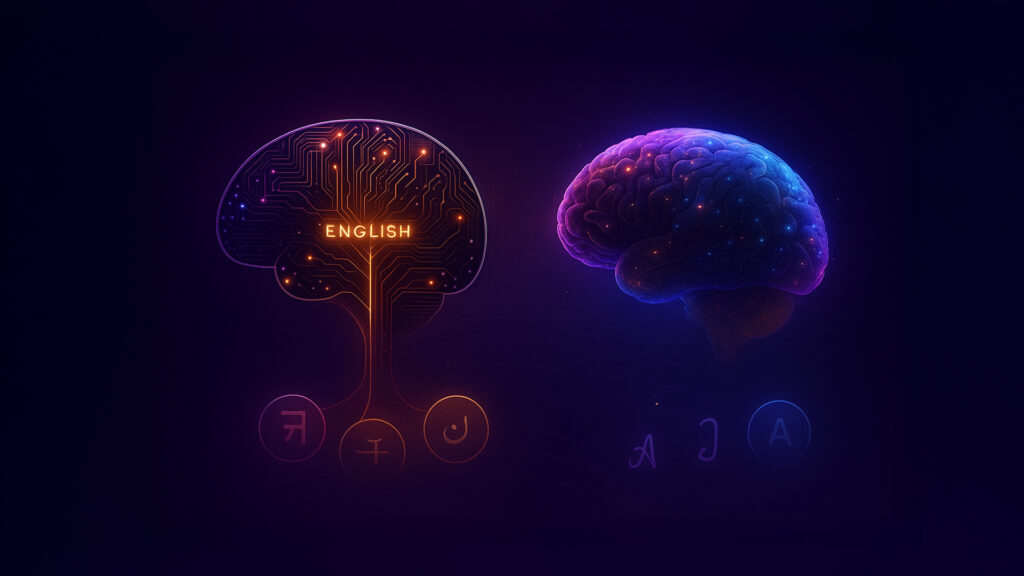
The invisible cost of forcing all human knowledge through one linguistic filter.
The Middleman Problem
Imagine having to conduct all your business through a translator who only understands one way of thinking. Every conversation, every nuance, every cultural reference has to pass through this single intermediary before reaching its destination.
That translator might be brilliant, but something gets lost in every exchange. Subtle meanings disappear. Cultural context evaporates. Complex ideas get simplified into whatever concepts the translator happens to understand.
This is exactly what's happening in AI systems today, and most people don't even realize it.
How AI Really Processes Language
Here’s what actually happens when you ask ChatGPT a question in Hindi, Arabic, or Mandarin:
The system doesn’t think in Hindi, Arabic, or Mandarin. It translates your question into English-shaped concepts, processes those concepts using English-learned patterns, then translates the result back into your language.
It’s like having a conversation with someone who can only think in English but speaks multiple languages. They might give you grammatically correct responses in your language, but the thinking behind those responses remains fundamentally English.
Every non-English interaction pays what we call the "Translation Tax"—a hidden performance cost that accumulates with every exchange.
The Compression Problem
This creates something troubling: concept compression.
When AI encounters ideas that don’t map neatly onto English concepts, it doesn’t preserve their uniqueness. Instead, it compresses them into the nearest English equivalent, losing what made them distinct.
Consider the Arabic concept of “tarab” (طرب—(a state of musical ecstasy where the listener becomes so moved by music that they lose themselves in the experience. AI systems reduce this to “musical enjoyment” or “being moved by music,” missing the profound spiritual and cultural dimensions that make tarab meaningful to Arabic speakers.
The same happens with German “Fernweh” (the ache for distant places), Korean “nunchi” (social awareness), or Yiddish “kvell” (bursting with pride). Each gets flattened into simpler English approximations.
We're systematically losing the intellectual and emotional precision that different cultures have developed over centuries.
The Performance Penalty
But the Translation Tax isn’t just about cultural sensitivity. It creates measurable performance degradation.
When AI processes information through this English bottleneck, it uses more computational resources, takes longer to reach conclusions, and often produces less accurate results for non-English contexts.
Think about it: if a system has to internally translate every concept before processing it, then translate the results back, it’s doing extra work at every step. This computational overhead compounds when dealing with complex reasoning tasks.
Users in non-English languages aren't just getting culturally inappropriate responses—they're getting objectively worse AI performance.
The Knowledge Accessibility Crisis
Perhaps most troubling is how this bottleneck affects access to human knowledge.
Thousands of years of accumulated wisdom in traditional Chinese medicine, Islamic scholarship, indigenous environmental knowledge, or African philosophical traditions become less accessible to AI systems because they can’t be easily mapped onto English conceptual frameworks.
This isn’t about translation quality. Even perfect translation misses the deeper issue: these knowledge systems were developed within specific cultural and linguistic contexts that give them meaning. When you strip away that context and force everything through English categories, you lose the very thing that makes the knowledge valuable.
We're creating AI systems that are systematically blind to most of human intellectual achievement.
The Scaling Problem
As AI becomes more powerful and pervasive, this bottleneck becomes more dangerous.
When AI systems make decisions about healthcare, education, legal systems, or governance, their English-centric processing affects billions of people who don’t think in English frameworks.
Imagine AI-powered medical diagnosis systems that can only understand symptoms when described using Western medical terminology. Or educational AI that can only recognize intelligence when expressed through English academic patterns. Or legal AI that can only reason using Anglo-American legal concepts.
The Translation Tax isn't just about user experience—it's about AI's ability to serve human diversity fairly.
The Innovation Question
This bottleneck represents both a crisis and an opportunity.
What if AI systems could process information directly in the conceptual frameworks of different cultures? What if they didn’t need to translate everything through English before understanding it?
What if instead of losing cultural nuance, AI could preserve and even synthesize insights across different ways of thinking?
But how would such systems even work?
The Architecture Challenge
Current AI architecture assumes there’s one universal way to organize concepts and relationships. Everything gets mapped onto this single conceptual structure, which happens to be optimized for English.
Alternative approaches might require fundamentally different architectures. Systems that could maintain multiple conceptual frameworks simultaneously. AI that could think directly in different cultural patterns rather than translating between them.
But is such a thing even possible with current technology?
What would training data look like for AI that doesn't rely on English as a conceptual bridge?
How could you preserve cultural meaning structures without creating incompatible AI systems?
The Questions We Should Be Asking
The Translation Tax reveals a deeper architectural problem in how we build AI systems.
Is forcing all human knowledge through one linguistic filter the best approach, or just the easiest?
What would AI look like if it could think natively in multiple cultural frameworks?
Could such systems actually be built, or are we limited by fundamental constraints in how AI learns?
And if alternative approaches are possible, what would they mean for the billions of people currently paying the Translation Tax?
The Urgent Need
Every day, more human knowledge gets processed through AI systems. Every day, more people rely on AI for important decisions. Every day, the Translation Tax extracts its cost from non-English speakers.
This isn’t just a technical problem to solve eventually. It’s an architectural challenge that affects how fairly AI serves humanity right now.
The question is: are we going to accept this bottleneck as inevitable, or start exploring alternatives?
And what would those alternatives even look like?
Priya M Nair and Nipuna Abeykoon are the founders of ZWAG and creators of Mātṛ UIM. These blogs are part of their research exploring the intersection of language, culture, cognition and future of intelligence – both artificial and human.